
Internet
What is internet?
Internet:-
Internet is a large collection of computers all over the world that are connected to one
another. It is a global network of computers. These computers are connected through
different telecommunications links like:
Phone lines
Fiber optics lines
Satellites and wireless connections
Internet is used to find information stored on the computers called hosts or servers.
These computers use a common protocol called TCP/IP for communication. TCP/IP stands
for Transmission Control Protocol / Internet Protocol. Each computer connected to the
Internet can act as host. A host computer provides information to the people.
People can find information about books, magazines, encyclopedia and other types of
material on the Internet. They can get expert opinions on any topic. They can also
communicate with world community on different subjects. The Internet has made this world a global village.
Briefly describe the history of internet.
The work on Internet was started in 1960s during the cold war of Russia and America.
America wanted to communicate with its Armed Forces. A network of four computers was
developed in the beginning. The project was handed over to DARPA (Defense Advanced
Research Project Agency). DARPA started connecting computers at different universities
and defense companies.
Different universities and research organizations also started the development of their own networks to share information and data with other people. After a few years, all
networks of universities and research organizations were connected by DARPA with each other to make the world’s biggest network. This network is now known as Internet.
In 1989, all previous networks were replaced by NSFNET of National Science
Foundation. The Internet facility was now available to common people.
Briefly describe the working of internet.
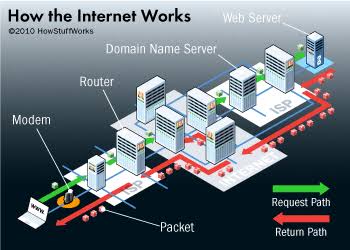
The Internet is a collection of millions of computers. These computers are linked
together on a computer network. The network is used by the computers to communicate with
one another. A personal computer can be connected to Internet by using phone lines, DSL or cable modem. These devices communicate with the server of Internet service provider.
A computer in a university or business is usually connected with local area network using network interface card (NIC). The business or university connects its LAN with an ISP using high-speed phone line like T1 line. A T1 line can handle approximately 1.5 million bits per second. A normal phone line with modem can handle 30,000 to 50,000 bits per second.
Internet service providers are connected to larger ISPs. The largest ISPs maintain fiber-
optic backbones for an entire region. Backbones are connected through fiber optic lines,
submarine cables or satellite links. In this way, every computer on the Internet is connected to every other computer.

What do you mean by addressing schemes?How many addressing schemes are used on the internet?
Discuss briefly
Addressing Scheme:-
Internet addresses are used to access different computers on the Internet. Each computer on the Internet has a unique address. This address is used to establish a connection
with that computer. There are two types of addressing schemes on the Internet known as IP
addressing and DNS addressing.
1.IP Addressing:-
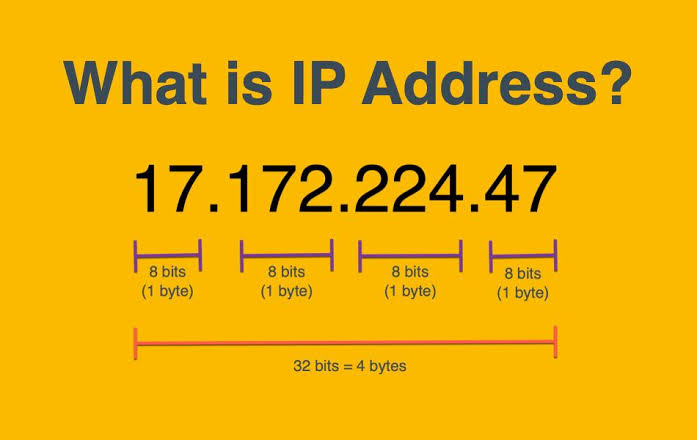
IP address is a unique number that refers to a computer connected to the Internet. IP
stands for Internet Protocol. The two types of IP addressing schemes are called IPv4 and
IPv6. IPv4 address is a 32-bit number and consists of four numbers separated by period. Each number is between 0 and 255. These numbers are known as octets. An example of IP address is 127.80.144.30. The address space for IPv4 is quickly running out due to the rapid growth of the Internet. IPv6 was introduced to increase the number of IP address on the Internet. IPv6 address consists of 16 bytes (128 bits).
A server on the Internet has a static IP address. It does not change very often. When a
computer connects to the Internet, it also gets an IP address by the ISP. This IP address is
used only during the session and is not static.

2.DNS Addressing:-
IP address is difficult to remember for the users. All servers on the Internet also have
human-readable names called domain name. A domain name consists of text instead of
number. It corresponds to an IP address of a server that hosts a website. The domain name is
easier to remember than IP address.google.com is an example of domain name.
Each domain name has a top-level domain that indicates the type of organization associated with the domain name. The .com in google.com indicates that the server is maintained by a commercial organization. The country codes also serve as top-level domains.
For example, Pakistan’s top-level domain is pk.
Internet Corporation for Assigned Names and Numbers (ICANN) is a group that assigns and controls the top-level domains. A method used to store domain names and corresponding IP addresses is called domain name system (DNS).
Some of the commonly used top-level domains are as follows:

Domain Types:-
- .Com Commercial organisation
- .edu Educational organisation
- .gov Government department
- .mil Military organisation
- .net Network providers
- .org Non-profit organisations





Web browsing or surfing| Some popular web browsers name.

Web browsing:-
Web browsing is a process of searching information on the World Wide Web. A
software used to search and view web pages is known as web browser. A web acts as an
interface between the user and the Internet. It can display text and graphics.
The browser contacts a web server and sends a request for the required information.
The web server searches for the requested web page and sends it to the web browser. The
browser receives the information and then displays it on the user’s computer.
Some popular web browsers are as follows:
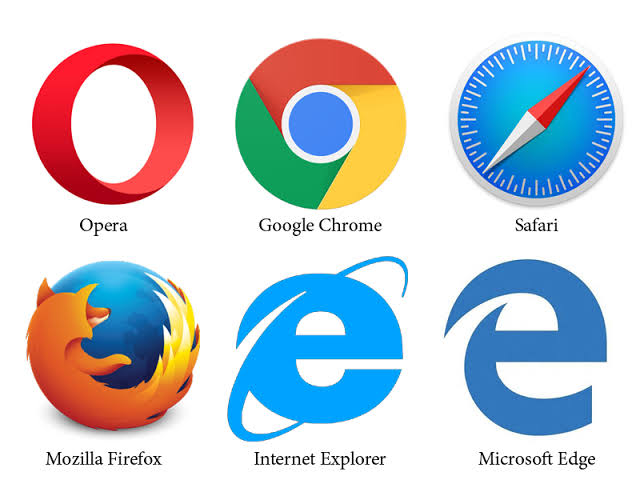
.Internet Explorer
.Mozilla Firefox
.Google Chrome
.Opera
.Safari
 Learn more